How Much Does eBay Take From a Sale? UK & US Fees Explained

Short answer: In the UK, eBay takes nothing from a private seller’s sale — no final value fee at all. A UK business seller pays 5% to 14.9% by category, plus a 0.35% regulatory fee, a 30p or 40p per-order fee, and 20% VAT on those fees. In the US, eBay takes 13.6% plus $0.40 per order. Zyrro breaks down the numbers.
How Much Does eBay Take From a Sale in the UK?
There is no single UK answer, because eBay charges private sellers and business sellers completely differently — and Google’s own answer box says exactly that. If you are a private seller clearing out your own belongings, eBay takes £0 from your sale. eBay’s own UK page for private sellers says it plainly: it is now free for UK-based private sellers to sell on eBay, and you will not pay final value fees or regulatory operating fees when your items sell. The one exception is motors — cars, motorcycles and other vehicles have their own fees.
If you are registered as a business seller, eBay takes a final value fee that depends on your product’s category, plus two smaller charges and VAT. The final value fee runs from 5% to 14.9% of the total amount of the sale. On top of that comes a regulatory operating fee of 0.35% and a per-order fee of 30p on orders of £10 or less, or 40p on orders over £10. All of those fees are shown exclusive of VAT, and VAT at 20% is added on top of the fees themselves — not on your sale price.
The category is what decides your rate, so here is eBay UK’s own table for business sellers, from its official fees page last updated 30 September 2026:
| Final value fee | Categories (business sellers, eBay UK) |
|---|---|
| 5% | NFTs |
| 9.9% | Clothes, Shoes & Accessories; Home, Furniture & DIY; Garden & Patio; Health & Beauty; Baby; Cameras & Photography; Musical Instruments; Media; Toys & Games; Art; Antiques; Coins; Stamps; Business, Office & Industrial |
| 10.9% | Mobile Phones & Communication; Computing; Sound & Vision |
| 11.9% | Vehicle Parts & Accessories; Sporting Goods; Gift Cards & Coupons; Dolls & Bears; Pottery & Glass; Collectables |
| 12.9% | Crafts; Event Tickets; Pet Supplies; Wholesale & Job Lots; Everything Else; Electronic Smoking; Women’s Bags & Handbags up to £800; Watches up to £750 |
| 14.9% | Jewellery & Watches up to £1,000, then 4% on the part above £1,000 |
eBay UK final value fees for business sellers by category. Source: eBay UK “Fees for business sellers” help page, last updated 30 September 2026.
Notice what this means in practice. The categories most UK resellers actually sell in — clothes, homeware, media, toys, cameras, health and beauty — sit at 9.9%, not at the 12.9% figure many fee guides quote as the standard rate. That 12.9% is the rate for “Everything Else” and a handful of named categories. If your listing is categorised correctly, your fee is probably lower than the headline number you have seen elsewhere. The rate follows the category, so a wrong category on a listing can cost you real money on every sale.
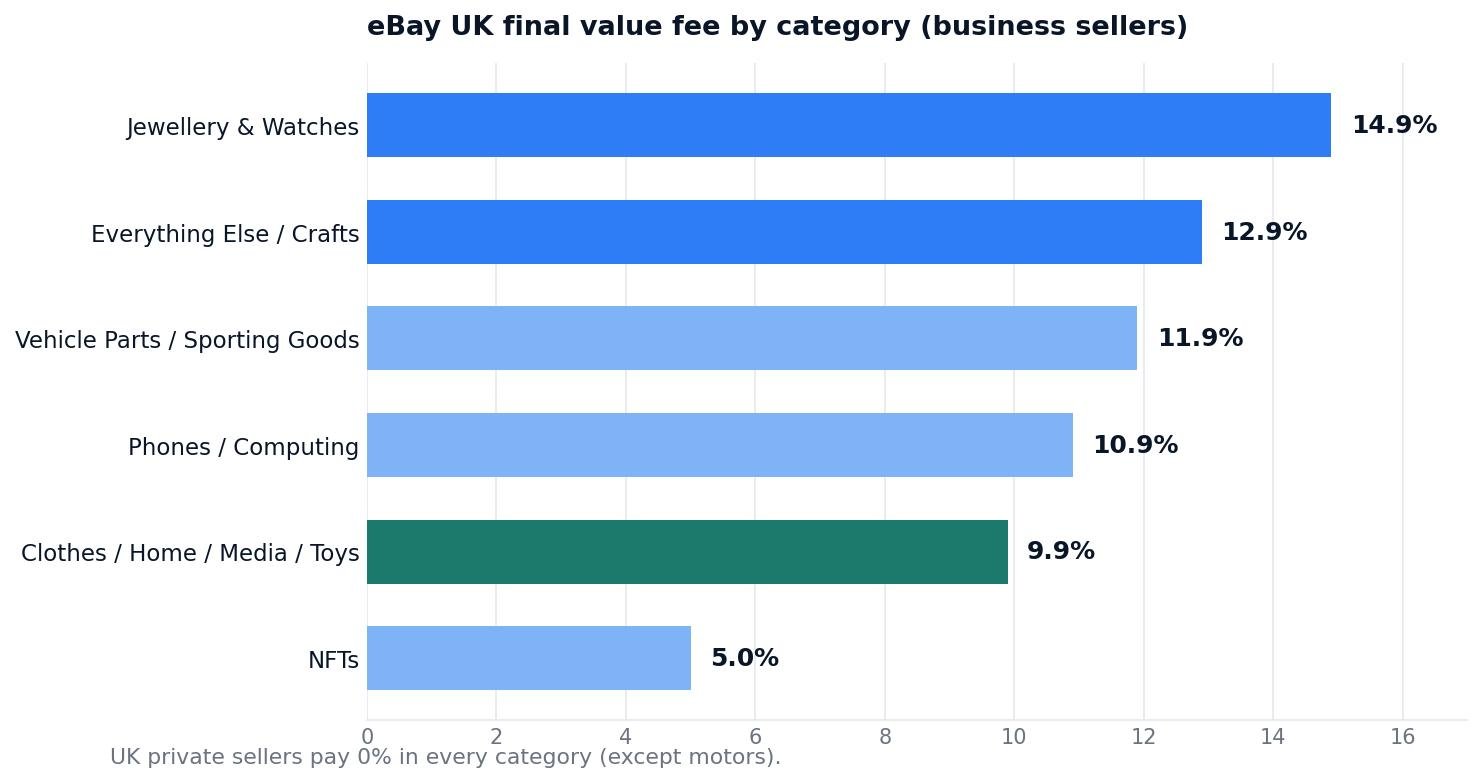
UK business sellers pay 9.9% in the biggest reseller categories — clothes, homeware, media and toys — and 12.9% only for “Everything Else” and the categories listed with it.
What Is eBay’s Final Value Fee — and What Is It Charged On?
The final value fee is eBay’s main charge, and it is the one sellers most often underestimate — because it is not charged on your item price alone. eBay charges it on the total amount of the sale: the item price, plus any postage the buyer pays, plus any sales tax or VAT on the order. A £50 item with £4.95 postage is charged on £54.95, not on £50. In the US the same rule applies, and the sales tax eBay collects from the buyer counts toward the fee base even though you never receive that tax money — eBay remits it to the state itself.
That is why the percentage you pay is always a little higher than it looks. On a $100 US sale with free shipping, the fee is a clean 13.6% plus $0.40. But add $8 of buyer-paid shipping and 7% sales tax, and the fee base becomes $62.06 on a $50 item — so eBay’s cut on that sale is $8.84, not the $7.20 you would get from 13.6% of $50 plus $0.40. Charging postage to the buyer does not dodge the fee; it increases the amount the fee is calculated on. Free postage is not free for you either — you pay the delivery cost yourself — but at least it keeps the fee base at your item price.
There is no separate payment processing fee in either market. The final value fee includes payment processing, so do not add a card fee on top. And there is no listing fee for your first 250 listings a month as a US seller without a store, or for your first 300 listings a month as a UK private seller — beyond those allowances each extra listing costs 35p in the UK and $0.35 in the US.
How Much Does eBay Take From a £100 Sale?
Worked through at the 12.9% “Everything Else” rate, a £100 sale with free postage costs a UK business seller £16.38 in total eBay fees, leaving £83.62. At the 9.9% rate that applies to clothes, homeware, media and toys, the same sale costs £12.78, leaving £87.22. And a UK private seller keeps the whole £100, because no fee applies at all.
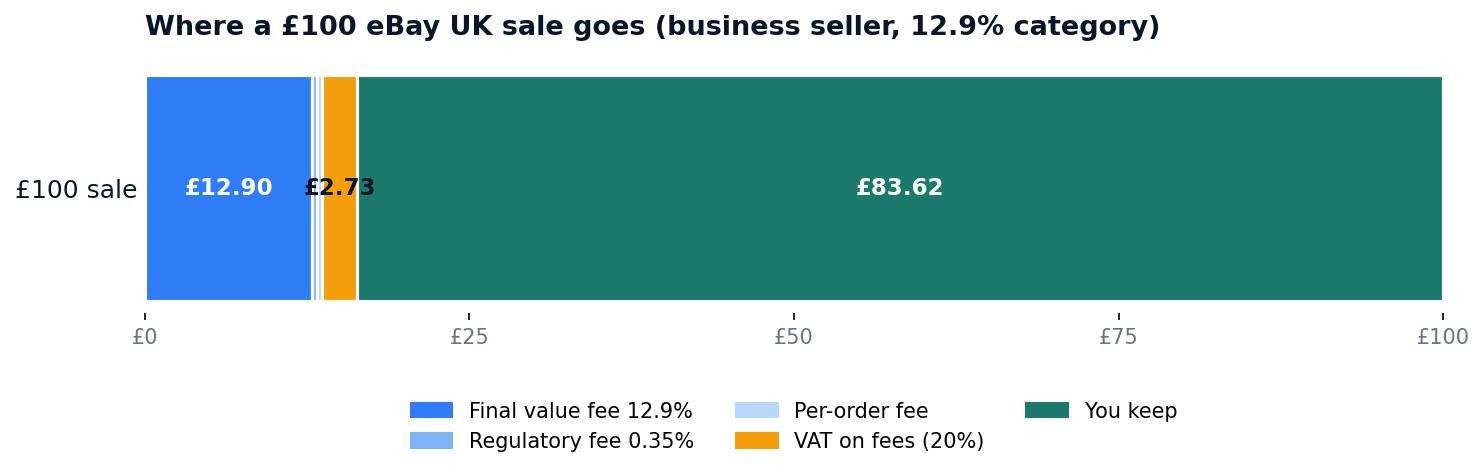
A £100 UK business sale at the 12.9% rate: £12.90 final value fee, £0.35 regulatory fee, £0.40 per-order fee and £2.73 VAT on the fees — £16.38 in total, leaving £83.62.
| UK business, 12.9% category | UK business, 9.9% category | UK private seller | |
|---|---|---|---|
| Sale price | £100.00 | £100.00 | £100.00 |
| Final value fee | − £12.90 | − £9.90 | £0.00 |
| Regulatory operating fee (0.35%) | − £0.35 | − £0.35 | £0.00 |
| Per-order fee | − £0.40 | − £0.40 | £0.00 |
| VAT at 20% on the fees | − £2.73 | − £2.13 | £0.00 |
| Total eBay fees | £16.38 | £12.78 | £0.00 |
| You keep | £83.62 | £87.22 | £100.00 |
Worked examples: a £100 sale with free postage. The 12.9% column matches Zyrro’s eBay Fee & Profit Calculator default exactly; change the rate to 9.9% in the calculator for clothes, homeware, media or toys.
Two details are worth knowing. First, the regulatory fee is not charged on tiny transactions — eBay waives it on sales of £1.00 or less in most categories (or £3.00 or less for trading cards). Second, the per-order fee drops to 10p on orders up to £10 in certain categories. Neither changes a normal sale much, but they show why small sales carry a proportionally heavier fee load: the 40p per-order fee alone is 4% of a £10 sale and 0.4% of a £100 sale.
For a smaller sale the same maths applies. A £50 sale at 12.9% costs a UK business seller £8.43 in total fees — £6.45 final value fee, £0.18 regulatory fee (0.35% of £50 is £0.175), £0.40 per-order fee, and £1.41 VAT on the fees — leaving £41.57 before your product and postage costs. That £8.43 figure is exactly what our calculator returns for the same sale, which is a useful cross-check that the numbers here are right.
How Much Does eBay Take From a Sale in the US?
In the United States the answer is simpler, because the rate barely varies by category. For most categories, eBay takes a final value fee of 13.6% of the total sale on the portion up to $7,500, and 2.35% on anything above $7,500. On top of that comes a per-order fee of $0.30 on orders of $10 or less, and $0.40 on orders over $10. There is no regulatory fee and no VAT for US sellers, and payment processing is included in the 13.6%.
On a $100 sale with free shipping and no sales tax, eBay takes $13.60 plus $0.40 — $14.00 in total — and you keep $86.00 before your own product and shipping costs. On a $50 sale with free shipping it takes $6.80 plus $0.40, which is $7.20, leaving $42.80. A few categories differ: books, movies and music pay 15.3%, while sellers with a Basic eBay Store or above pay 12.7% in most categories instead of 13.6%.
Compare the two markets on the same £100 / $100 sale and the UK business seller at the 12.9% rate pays more than the US seller — £16.38 against $14.00 — because of the regulatory fee and the VAT charged on the fees. But the UK business seller in a 9.9% category pays less than the US seller, at £12.78. And the UK private seller pays nothing at all, which is the biggest gap in the whole comparison. Where you sell, what you sell, and whether you are registered as a business all move the answer by pounds on every single order.
Why Is My UK eBay Fee Higher Than the Headline Rate?
This is the question UK business sellers ask most, and the answer is the stack of charges that sit on top of the final value fee. The headline rate — say 12.9% — is only the first line. The regulatory operating fee adds 0.35% of the total sale including postage and tax. The per-order fee adds a flat 30p or 40p. Then VAT at 20% is charged on all of those fees together. On a £100 sale at 12.9%, the fees before VAT are £13.65, and the VAT on them is £2.73 — so the VAT alone is nearly 3% of your sale price, and the real total is 16.38% of the sale, not 12.9%. For the VAT on its own — which fees it applies to, worked £100 and £50 examples, and how VAT-registered sellers reclaim it — see our guide to eBay VAT on fees.
That is also why two sellers can pay different amounts on the same £100 sale. A clothes seller at 9.9% pays £12.78 in total, while a jewellery seller at 14.9% pays £18.78 — £14.90 final value fee, £0.35 regulatory, £0.40 per-order, and £3.13 VAT. Same price, same postage, just over £6 difference, decided entirely by the category. If your fee looks wrong, the first thing to check is the category your listing sits in, not the arithmetic.
Do Private Sellers Pay eBay Fees in the UK?
No — not on the sale itself. Since eBay removed final value fees for UK private sellers, a private seller pays no final value fee, no regulatory operating fee and no per-order fee when an item sells. That is confirmed on eBay’s own UK private-seller page, and it is the reason so many UK sellers ask whether they should stay private rather than register as a business. The answer is not as simple as the £0 fee suggests: selling as a business when you are really trading — buying stock to resell for profit — is a tax and account-status question, not a fee-saving trick, and eBay can reclassify an account that is clearly trading.
Private sellers still pay for some things. Listings are free for the first 300 each month, then 35p per listing. Optional listing upgrades cost extra if you choose them. Selling to a buyer outside the UK adds a 3% international fee. And if a payment dispute goes against you, eBay charges a £16.80 dispute fee. Motors are the big exception: cars, motorcycles and other vehicles have their own listing and final value fees, so the free-selling rule does not apply to them at all.
What Makes eBay Take More Than the Standard Rate?
Four things push eBay’s cut above the standard rate, and three of them are choices you make. Promoted Listings is the biggest: you set an ad rate, typically anywhere from 2% to 100% of the sale, and eBay charges it on the total sale — including postage and tax — but only if the item sells within 30 days of a click on your ad. At an 8% ad rate on a $100 US sale, eBay’s total share rises from $14.00 to about $22.40. Promotion works, but it is the most expensive line on the receipt, so set the rate deliberately rather than accepting a suggested one.
International sales add a fee on top: 1.65% of the total sale for US sellers, and 3% for UK private sellers delivering outside the UK. Below Standard seller status adds 6 percentage points to the final value fee — a 13.6% US fee becomes 19.6% — which is why late dispatch and unresolved cases are not just reputation problems. And refunds cost you twice: eBay returns the final value fee on a refunded order, but you still pay your own return postage, and in the US a $20 dispute fee applies if a chargeback is found against you. See how to refund a buyer on eBay for the steps, the 90-day limit and the exact cost.
One thing that pushes the fee down is an eBay Store subscription. A Basic Store costs $27.95 a month on monthly renewal ($21.95 on annual billing) and drops most categories from 13.6% to 12.7% in the US. That 0.9-point saving pays for the subscription at roughly $3,106 of monthly sales on monthly renewal — below that volume, the store costs more than it saves in fees, though the extra free listings may still make it worthwhile.
How Can You Pay Less in eBay Fees?
You cannot negotiate the headline rates, but you can change almost everything around them. First, check your category: a listing in the wrong category can cost 3 to 5 percentage points on every sale, and the category table above shows how wide the spread is. Second, use Promoted Listings like a budget, not a default — a low ad rate on a listing that would sell anyway is pure cost, so promote only the stock that needs the push. Third, keep your seller status above Below Standard, because the 6-point penalty is the single most expensive avoidable charge in the whole fee structure. Fourth, price with a calculator before you list, not with a guess after the payout lands: run your price, product cost, postage cost and any promoted rate through the numbers and read off your real profit, margin and break-even price.
Zyrro’s free eBay Fee & Profit Calculator does exactly that for UK and US sellers, with the 13.6% US rate and the 12.9% UK business rate built in and every rate editable — so if your category pays 9.9%, or you are a UK private seller paying nothing, you can change the rate and see the result instantly. For the full method — researching sold prices, setting the price and choosing auction or Buy It Now — see our guide to how to price items on eBay. It also handles promoted listings, VAT on fees and expected returns, which the headline percentages on their own never show you.
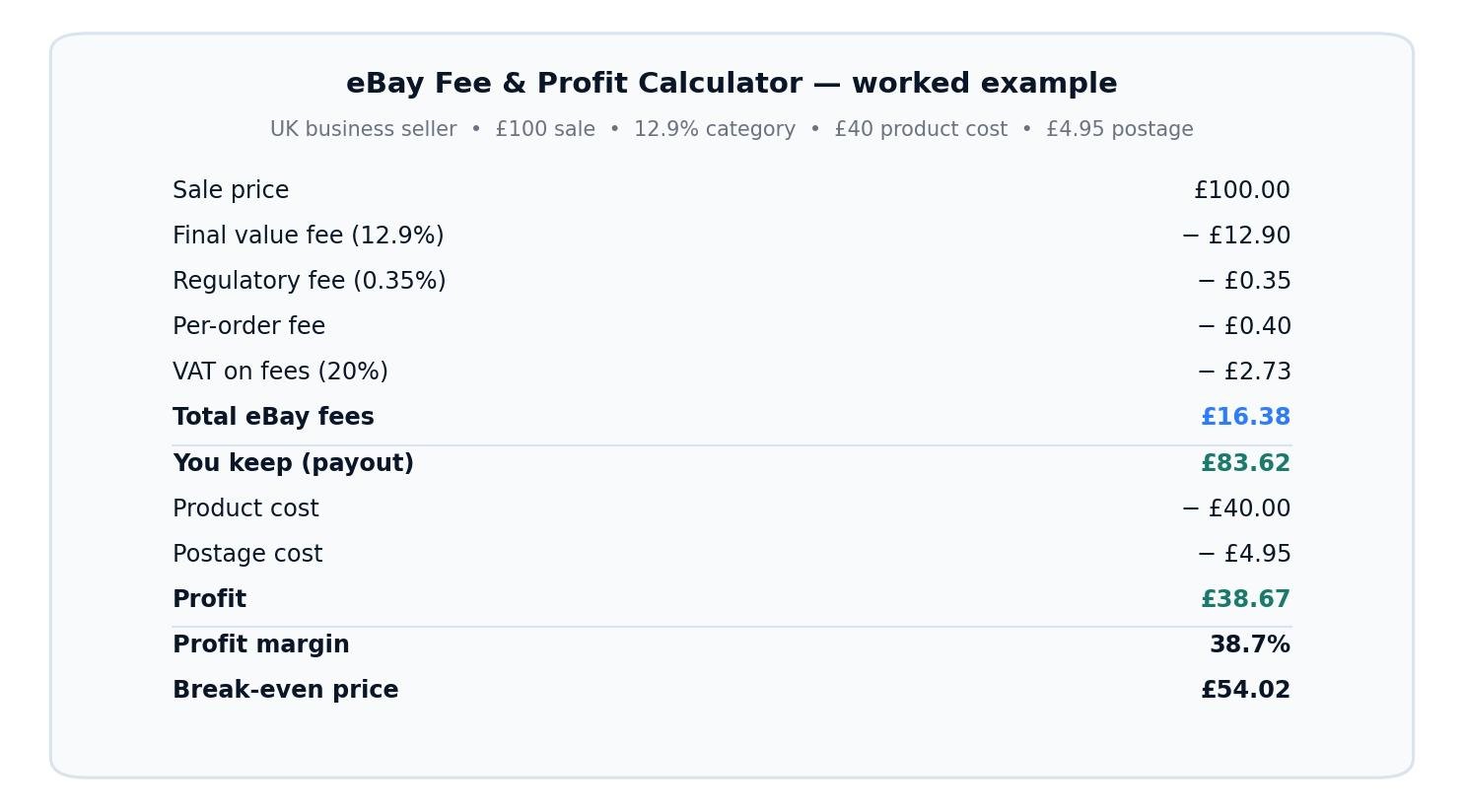
Run your own numbers before you list — the calculator shows total fees, what you keep, margin and break-even price for UK and US sellers.
For the full picture of eBay fees beyond a single sale — store tiers, VAT and the other calculators coming next — see our eBay seller tools hub. And if you also sell on TikTok Shop, the comparison is worth making: TikTok takes 6% in the US and 9% in the UK, far below eBay’s rates, but charges affiliate commission on top — our guide to how much TikTok Shop takes from a sale runs the same comparison with worked examples.
Frequently Asked Questions About eBay Fees
How much does eBay take from a $100 sale?
In the US, eBay takes $14.00 from a $100 sale with free shipping and no sales tax — 13.6% final value fee ($13.60) plus a $0.40 per-order fee, leaving $86.00 before product and shipping costs. In the UK, a business seller pays £16.38 at the 12.9% rate, or £12.78 at 9.9% for clothes and homeware; a private seller pays nothing.
What percentage does eBay UK take?
It depends on seller type and category. UK private sellers pay 0% — no final value fee at all. UK business sellers pay 5% to 14.9% by category, plus a 0.35% regulatory fee, a 30p or 40p per-order fee, and 20% VAT on those fees. Most big reseller categories, like clothes and homeware, sit at 9.9%.
Does eBay take 15%?
Not as a standard rate. In the US the standard rate is 13.6% for most categories, though books, movies and music pay 15.3%. In the UK the highest business rate is 14.9% for jewellery and watches, and most categories pay 9.9% to 12.9%. Private sellers in the UK pay 0%.
How do I calculate eBay fees in the UK?
Take the total sale including postage, multiply by your category’s final value fee rate, add the 0.35% regulatory fee and the 30p or 40p per-order fee, then add 20% VAT on those fees. A £100 sale at 12.9% is £12.90 + £0.35 + £0.40 = £13.65, plus £2.73 VAT — £16.38 in total.
Does eBay charge a fee to sell in the UK?
For private sellers, no — selling is free, with no final value fee or regulatory fee, except for motors. You still pay 35p per listing beyond your first 300 free listings a month, and a 3% international fee on overseas deliveries. For business sellers, yes — 5% to 14.9% by category, plus regulatory and per-order fees and VAT.
How much will eBay take from my sale in the UK?
If you are a private seller, nothing — you keep the full sale price, before your own postage cost. If you are a business seller, it depends on your category: on a £50 sale, eBay takes £8.43 at the 12.9% rate, or £6.63 at the 9.9% rate. Check your listing’s category first — it decides the rate.
Rates in this article were verified against eBay UK’s official fees pages for business and private sellers (last updated 30 September 2026, read 2 November 2026) and eBay’s US selling-fees page as reported by its fee guides (verified 31 October 2026). eBay can change fees with notice to sellers, so always confirm your exact rate in Seller Hub before setting prices. This article is general information, not financial advice. Zyrro’s free calculators use the same verified rates and let you change any rate to match your own account.