eBay VAT on Fees Explained for UK Sellers (2026)

Short answer: Yes — eBay charges 20% VAT on its selling fees to UK business sellers. The VAT is added to the final value fee, the per-order fee and the regulatory fee, so on a £100 sale it adds £2.73. UK private sellers pay no VAT on fees, because they pay no selling fees at all. Zyrro breaks down the numbers.
Does eBay Charge VAT on Fees?
Yes. If you sell on eBay.co.uk as a business seller, eBay adds VAT at 20% to the fees it charges you. This is not VAT on your sale price, and it is not VAT you charge your buyer — it is VAT on eBay’s own charge to you, for using its marketplace. eBay bills UK business sellers from eBay (UK) Limited, so UK VAT applies to its fees in the normal way. The charge applies whether or not you are VAT-registered yourself. The difference registration makes is not whether you pay the VAT — it is whether you can claim it back.
That distinction is where most of the confusion comes from. Many sellers see a VAT line on their eBay invoice and assume it means they are VAT-registered, or that eBay is charging VAT on their behalf. Neither is true. The VAT on your invoice is eBay’s VAT, on eBay’s fees. Your own VAT obligations — whether you must register, charge VAT on your sales and file returns — are a separate question, decided by your turnover and answered by HMRC’s rules, not by anything on an eBay invoice. Seeing VAT on an eBay invoice does not mean you are registered, and being registered does not stop eBay charging it.
The rate is 20%, the UK standard rate, and it has applied to UK sellers’ eBay fees for years. What has changed over time is the fee structure underneath it: since October 2024, UK private sellers pay no final value fee at all, while business sellers pay a category-based final value fee. The VAT sits on top of whichever fees apply to you. If you sell on eBay.com as a US seller, UK VAT does not apply to your fees at all — VAT is a UK and EU matter, and US sellers deal with sales tax instead.
Which eBay Fees Have VAT Added?
VAT at 20% is added to every fee eBay charges a UK business seller. The three fees on every sale are the final value fee, the per-order fee and the regulatory operating fee, and all three attract VAT. The same applies to the optional fees: Promoted Listings ad fees, listing upgrade fees and eBay Store subscription fees all have VAT added. There is no fee on your invoice that escapes it.
| eBay fee (UK business sellers) | Rate | VAT at 20%? |
|---|---|---|
| Final value fee | 5%–14.9% by category | Yes |
| Per-order fee | £0.30 (orders £10 or less) / £0.40 (over £10) | Yes |
| Regulatory operating fee | 0.35% of the total sale | Yes |
| Promoted Listings ad fee | Your chosen ad rate (2%–100%) | Yes |
| Listing upgrades (bold, subtitle, gallery) | Fixed fee per listing | Yes |
| eBay Store subscription | Monthly fee by tier | Yes |
| International fee (business sellers) | 1.05%–2.0% by destination | Yes |
Every fee eBay charges a UK business seller carries 20% VAT. Source: eBay UK “Fees for business sellers” help page (last updated 30 September 2026) and eBay’s UK fee guides, checked 2 November 2026.
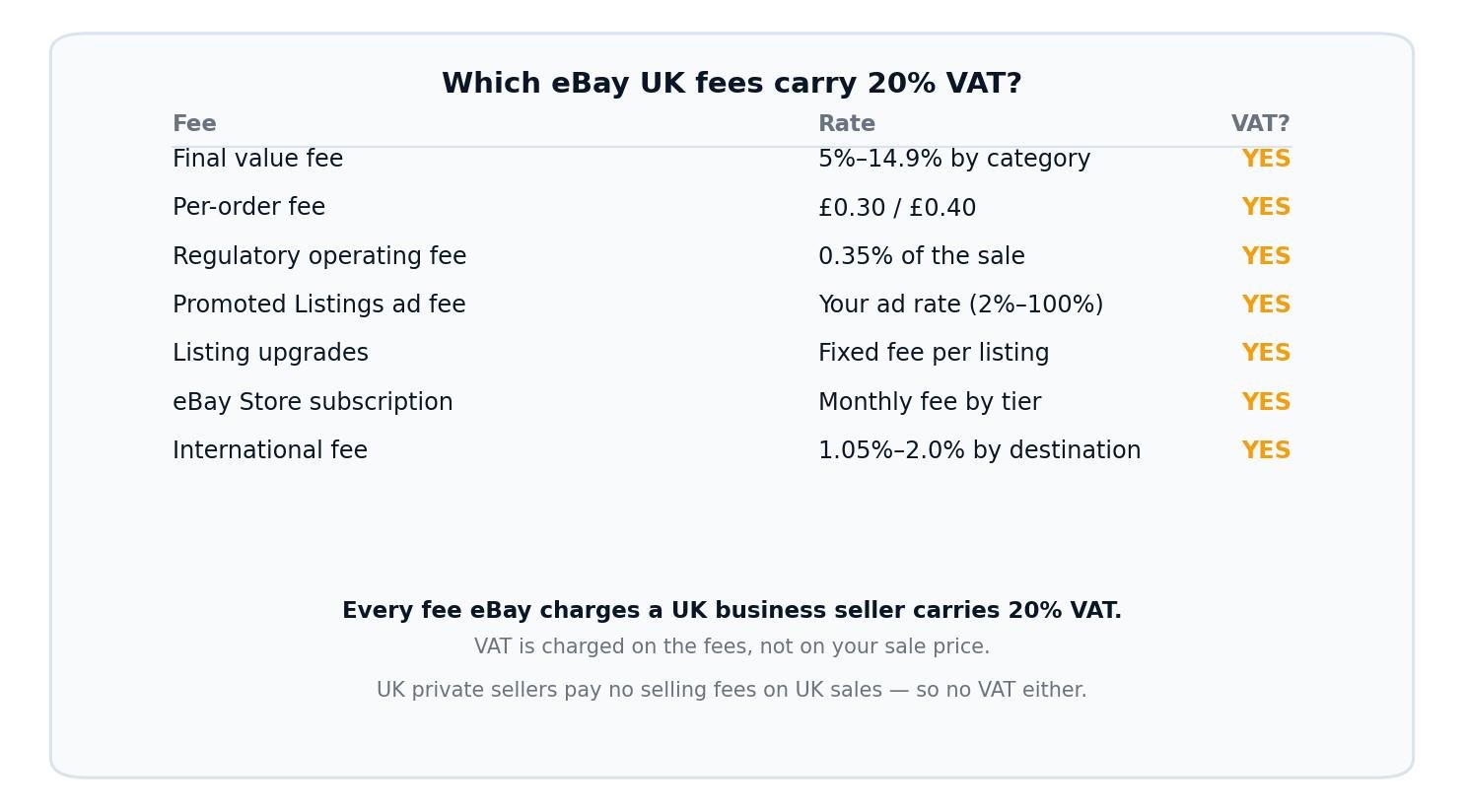
VAT applies to every eBay fee, not just the final value fee — including Promoted Listings ad fees and your Store subscription.
Two things are worth noting about the table. First, the final value fee is the only one that varies much: it runs from 5% to 14.9% depending on your product’s category, with 9.9% for the big reseller categories — clothes, homeware, media, toys, cameras, health and beauty — and 12.9% for “Everything Else”. Second, the VAT is always calculated on the fees, never on your sale price. On a £100 sale the fees before VAT are £13.65 at the 12.9% rate, and the VAT is 20% of £13.65 — which is £2.73, or 2.73% of your sale price. Sellers who budget “20% VAT” against the whole sale overstate the cost by a wide margin; sellers who forget it entirely understate their fees by nearly 3 points.
How Much VAT Do You Pay on eBay Fees?
Worked through on a £100 sale at the 12.9% “Everything Else” rate, a UK business seller who is not VAT-registered pays £2.73 in VAT on eBay’s fees — and £16.38 in total fees, keeping £83.62 before product and postage costs. The same sale in a 9.9% category, like clothes or homeware, costs £2.13 in VAT and £12.78 in total fees, keeping £87.22.
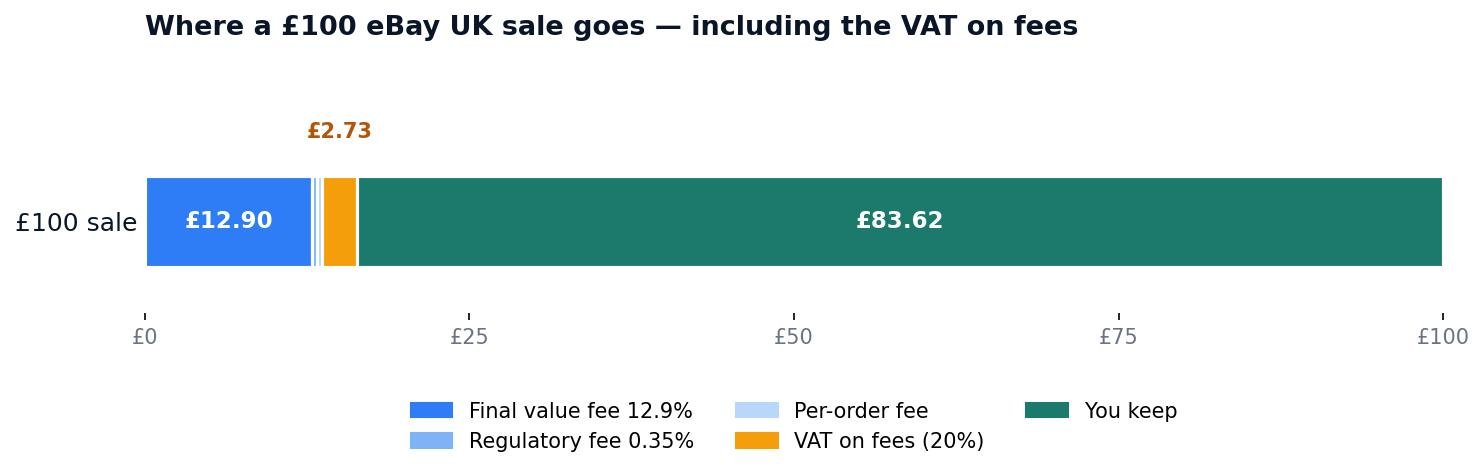
A £100 UK business sale at the 12.9% rate: £12.90 final value fee, £0.35 regulatory fee, £0.40 per-order fee and £2.73 VAT on the fees — £16.38 in total, leaving £83.62.
| £100 sale, 12.9% category | £100 sale, 9.9% category | £50 sale, 12.9% category | |
|---|---|---|---|
| Final value fee | − £12.90 | − £9.90 | − £6.45 |
| Regulatory operating fee (0.35%) | − £0.35 | − £0.35 | − £0.18 |
| Per-order fee | − £0.40 | − £0.40 | − £0.40 |
| Fees before VAT | £13.65 | £10.65 | £7.03 |
| VAT at 20% on the fees | − £2.73 | − £2.13 | − £1.41 |
| Total eBay fees | £16.38 | £12.78 | £8.43 |
| You keep | £83.62 | £87.22 | £41.57 |
Worked examples before product and postage costs. The £100 and £50 figures at 12.9% match Zyrro’s eBay Fee & Profit Calculator exactly — run your own price through it to check your category. Penny rounding: on the £50 sale the regulatory fee is exactly £0.175 and the VAT exactly £1.405, so the exact total is £8.43 even though the rounded lines add to £8.44.
Promoted Listings make the VAT bigger, because the ad fee is VAT-able too. Take the same £100 sale at 12.9% and promote it at a 5% ad rate: the ad fee is £5.00, the fees before VAT rise to £18.65, the VAT rises to £3.73, and the total eBay bill is £22.38, leaving £77.62. The VAT on the ad fee alone is £1.00 — easy to miss when you are judging whether a 5% ad rate is affordable, and exactly why promoted rates should be tested against your real margin, not your headline fee.
Scale the numbers up and the VAT becomes a line worth managing rather than ignoring. At the 12.9% rate, every £10,000 of sales carries £273 of VAT on eBay’s fees. Over a year of steady selling that is real money — either a cost you absorb, if you are not registered, or input VAT you reclaim, if you are. Which brings us to the question that decides which side of that line you sit on.
What Changes If You Are VAT-Registered?
If you are VAT-registered, the VAT eBay charges on its fees stops being a cost and becomes input VAT you reclaim on your VAT return. The fees themselves do not change — eBay still charges the same final value fee, per-order fee and regulatory fee, and still adds 20% VAT to them. What changes is that you get that VAT back from HMRC, so your real cost is the fees before VAT. On a £100 sale at 12.9%, a registered seller’s net eBay cost is £13.65 and they keep £86.35, against £16.38 and £83.62 for a seller who is not registered — a difference of £2.73 on every £100 sale.
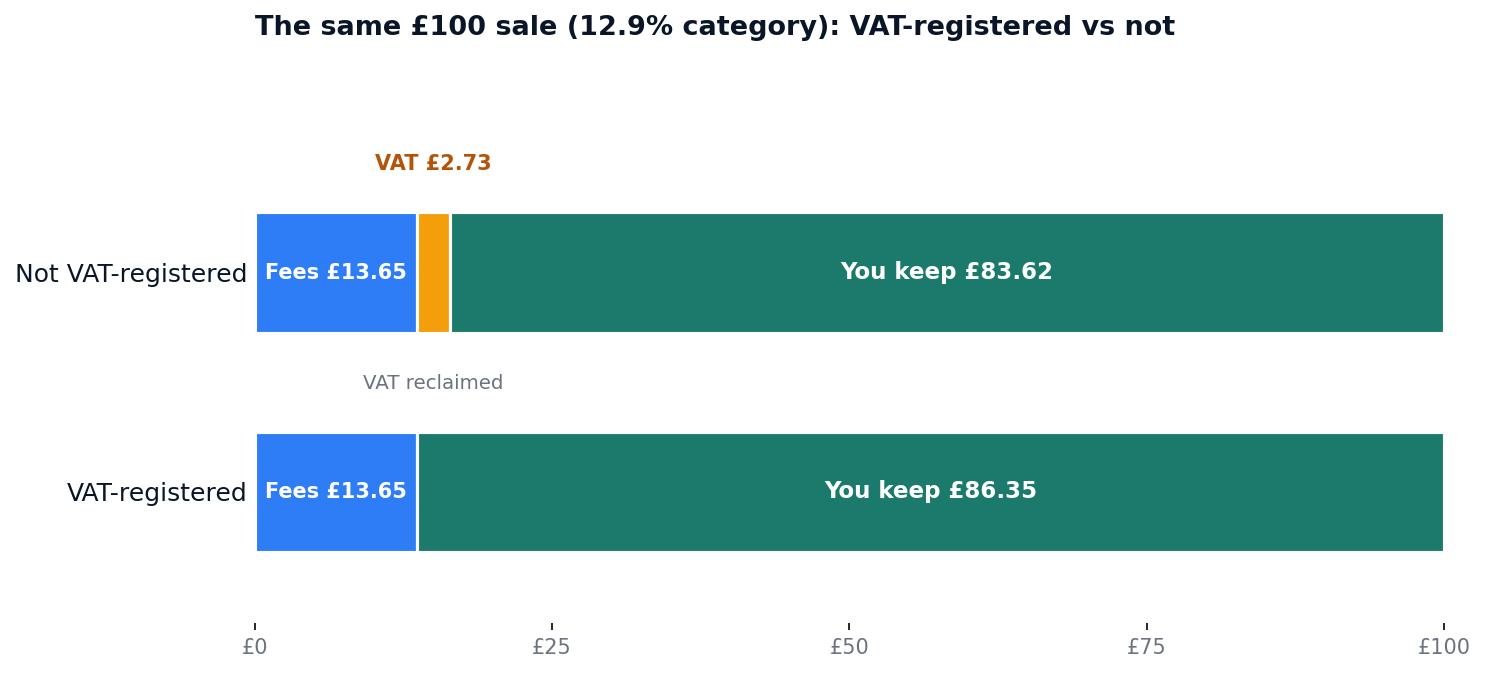
The same £100 sale, twice: not VAT-registered you keep £83.62; VAT-registered you reclaim the £2.73 and keep £86.35.
| £100 sale at 12.9% | Not VAT-registered | VAT-registered |
|---|---|---|
| eBay fees before VAT | £13.65 | £13.65 |
| VAT at 20% on the fees | £2.73 (a cost) | £2.73 (reclaimed) |
| Net eBay cost | £16.38 | £13.65 |
| You keep | £83.62 | £86.35 |
Registration does not change eBay’s fees — it changes who ultimately bears the VAT on them.
You must register for VAT when your VAT-taxable turnover passes £90,000 in any rolling 12 months, or when you expect it to in the next 30 days — and turnover means everything buyers paid you, not your profit, so a high-volume, low-margin reseller reaches the threshold faster than the profit figure suggests. Registering late carries backdated penalties, so the threshold is worth watching before you hit it, not after. Once registered, you charge VAT on your own sales and reclaim the VAT on your costs, including eBay’s fees — but only with proper invoices, so keep eBay’s monthly invoice, which breaks out the VAT. One exception to watch: sellers on the Flat Rate Scheme generally cannot reclaim input VAT on eBay’s fees, because the scheme replaces reclaim with a flat percentage — check the scheme rules before assuming the £2.73 comes back.
Registration is not free money, and it is not a decision to make for the eBay fees alone. Once registered, 20/120ths of every sale you make belongs to HMRC, which changes your pricing — a £100 sale becomes £83.33 before VAT, not £100. The reclaim on eBay’s fees is one line in a much bigger calculation, and whether registration pays depends on your turnover, your margins and what you buy. What is certain is the arithmetic in the table above: if you are registered and reclaiming, your eBay fees are 13.65% of a £100 sale at the 12.9% rate, not 16.38%.
Do Private Sellers Pay VAT on eBay Fees?
No — because UK private sellers pay no selling fees on UK sales, there is no fee for VAT to be charged on. Since eBay removed final value fees for UK private sellers, a private seller pays no final value fee, no regulatory operating fee and no per-order fee when an item sells in the UK, so the VAT line on a private seller’s account is £0. The one exception is motors: cars, motorcycles and other vehicles have their own fees, and VAT applies to those in the normal way.
Private sellers still meet VAT in two places. First, listings beyond the first 300 free each month cost 35p each, and VAT is added to those listing fees. Second, selling to a buyer outside the UK adds a 3% international fee, and that fee is charged inclusive of VAT. Neither changes the headline: for an ordinary UK sale, a private seller’s eBay bill — and the VAT on it — is nothing. That is also why the private-versus-business question matters so much for fees: the gap is not just the final value fee, it is the final value fee plus the VAT on it.
But the £0 fee is not a reason to stay private if you are really trading. Buying stock to resell for profit is a business activity, and eBay can reclassify an account that is clearly trading. The fee saving is real — £16.38 on every £100 sale at the 12.9% rate — but it is not a pricing strategy, and it does not change your tax position: eBay’s fee treatment and HMRC’s tax treatment are completely independent of each other, so zero eBay fees never means zero tax liability.
How to Check the VAT on Your eBay Invoice
The fastest way to see exactly what VAT you paid is your eBay invoice, not a calculator. In Seller Hub, go to the Payments tab, select All transactions, find the order and open View to see the Fee details section — it breaks out the final value fee, the regulatory operating fee and any other transaction fee for that order. For the monthly picture, eBay issues a single invoice that lists your fees and the VAT on them, broken out as its own line. That invoice is the document you need for a VAT return: it shows the VAT eBay (UK) Limited charged you, which is what a registered seller reclaims as input VAT.
Three things to check on the invoice. First, that the final value fee rate matches your listing’s category — a wrong category is the most common reason a fee looks too high, and the rate follows the category, not your account. Second, that the VAT is 20% of the fees, not 20% of the sale — if the VAT line looks like a fifth of your sale price, something is being misread. Third, that the billing entity is eBay (UK) Limited: if a fee were ever billed by an entity outside the UK, the VAT treatment would be different, and that is the detail an accountant will ask for first.
3 Mistakes Sellers Make With eBay VAT
1. Thinking the VAT on the invoice means they are VAT-registered. It does not. Every UK business seller sees VAT on their eBay invoice, registered or not. Registration is a separate HMRC status, decided by your turnover. If you are not registered, the VAT is simply a cost — budget for it in your pricing, at roughly 2.7 points on a £100 sale at the 12.9% rate.
2. Forgetting the VAT when pricing. Sellers who price from the headline final value fee — “12.9% off my £100 sale” — understate their real cost by £2.73 on every £100 sale, and by £1.00 more if they promote at 5%. Price from the total fees including VAT, not from the headline rate. Zyrro’s eBay Fee & Profit Calculator includes the VAT on fees in its result, so the number it shows is the number that actually leaves your account.
3. Applying US rules to a UK sale. US sellers pay no VAT on eBay fees — their fee is 13.6% plus $0.40 per order, with sales tax handled separately. UK sellers pay VAT on top of a category-based fee. Fee guides written for the US market will not mention VAT at all, which is why a UK seller following one can be surprised by the invoice. Our guide to how much eBay takes from a sale in the UK runs the full US-versus-UK comparison with worked examples, and our eBay seller tools hub has the calculators for both markets.
Frequently Asked Questions About eBay VAT on Fees
Does eBay charge VAT on fees?
Yes. eBay charges 20% VAT on its selling fees to UK business sellers — on the final value fee, the per-order fee, the regulatory operating fee, Promoted Listings ad fees and Store subscriptions. The VAT is calculated on the fees, not on your sale price, so on a £100 sale at 12.9% it adds £2.73.
Is there VAT on eBay fees UK?
Yes, for business sellers. eBay (UK) Limited adds 20% VAT to all of its fees for UK business sellers, whether or not the seller is VAT-registered. UK private sellers pay no VAT on fees because they pay no selling fees on UK sales. US sellers pay no UK VAT on their eBay fees.
Does eBay charge VAT on selling fees?
Yes — VAT at 20% applies to eBay’s selling fees in the UK, including the final value fee, the per-order fee and the regulatory operating fee. It also applies to Promoted Listings ad fees and listing upgrades. The VAT appears as its own line on your monthly eBay invoice.
When did eBay start charging VAT on fees?
eBay has charged VAT on its UK sellers’ fees for years — no single start date is published on its current fee pages. The rate is the UK standard rate of 20%. What changed in October 2024 is the fee underneath: UK private sellers stopped paying final value fees, so they stopped paying VAT on fees too.
Is there a VAT exemption on eBay fees?
There is no exemption from the charge itself — eBay adds 20% VAT to its fees for every UK business seller. The only way the VAT stops being a cost is VAT registration: a registered seller reclaims it as input VAT on their return. Sellers on the Flat Rate Scheme generally cannot reclaim it, so check the scheme rules first.
Do private sellers pay VAT on eBay fees?
No. UK private sellers pay no final value fee, no regulatory fee and no per-order fee on UK sales, so there is no fee for VAT to be charged on. The exceptions are motors, which have their own fees, and listing fees beyond the first 300 free listings a month, which do carry VAT.
Rates in this article were verified against eBay UK’s official fees pages for business and private sellers (last updated 30 September 2026, read 2 November 2026) and eBay’s UK fee guides (checked 2 November 2026). eBay can change fees with notice to sellers, so always confirm your exact rate in Seller Hub before setting prices. This article is general information, not tax or financial advice — for your own VAT position, speak to an accountant. Zyrro’s free calculators use the same verified rates and let you change any rate to match your own account.