
The battle between Elon Musk and Mukesh Ambani over India’s internet future just turned personal — and the numbers explain exactly why. On October 10, 2026, Musk took to X to accuse Ambani’s online supporters of what he called “absurd hypocrisy and hyperbole,” calling out the contradiction at the heart of the debate: critics say Starlink cannot compete with Jio’s rock-bottom prices, yet treat it as a dangerous competitive threat. Musk’s message was blunt — competition benefits ordinary Indians, and “Ambani’s profits will be lower, but he is not going out of business.” But behind the drama lies the question everyone is really asking: how much will Starlink cost in India, and is the Starlink India price actually worth it when Jio and Airtel are so cheap?
Here is the honest breakdown — the Starlink India price as it stands today, how it stacks up against every major Indian ISP, and our verdict on who should actually buy it.
How Much Will Starlink Cost in India? The Starlink India Price Breakdown
Starlink’s India website briefly showed a placeholder monthly price of Rs 8,600, along with a hardware kit priced at Rs 34,000 covering the dish, router, cables, and mounting equipment (reported by News18 on October 8, 2026). Starlink describes this as a placeholder figure, not a final tariff — commercial tariffs are still pending. But it is the only real number we have, and it tells a story.
For context, that Rs 8,600 figure is roughly 44 times India’s average monthly wireless revenue per user of Rs 196.04, per TRAI. The first-year cost at this pricing would work out to about Rs 1,37,200 — monthly fee times twelve plus the hardware kit.
What would you get for that money? Starlink claims unlimited data, a 30-day trial, more-than-99.9% uptime, plug-and-play self-installation, and connectivity that works in remote terrain where no tower reaches. Globally, Starlink delivers speeds of 25–220 Mbps with latency of 25–60 ms; in India, speeds are expected to be capped at 200 Mbps.
Worth noting: this isn’t the first number attached to Starlink in India. In 2025, Minister of State Chandra Sekhar Pemmasani said users may pay around Rs 3,000 per month — less than half the current placeholder. Whether the final commercial tariff lands closer to that estimate will decide everything about Starlink’s future in the country.
Starlink vs Jio vs Airtel vs BSNL: The Honest Price Comparison
Here is where the Musk-vs-Ambani drama meets reality. This is the comparison that matters:
| Provider | Monthly price | Speeds | The catch |
|---|---|---|---|
| Starlink | Rs 8,600 (placeholder) + Rs 34,000 kit | Up to 200 Mbps (India cap); 25–60 ms latency | Final tariff still pending; commercial launch expected 2026–27 |
| Jio Fibre | From Rs 399/month | High-speed fibre plans | Needs fibre infrastructure in your area |
| Airtel Xstream | From Rs 499/month | High-speed fibre plans | Needs fibre infrastructure in your area |
| BSNL | 200 Mbps ~Rs 899/month | Fibre plans, wide rural footprint | Service quality varies by circle |
Premium 1 Gbps fibre plans from leading ISPs run around Rs 3,999 per month — still less than half of Starlink’s placeholder price. And BSNL cut its 5,000 GB plan to Rs 799 back in January 2026.
The gap is staggering, and analysts have said so plainly: Bernstein estimates Starlink will be 10 to 14 times pricier than Indian broadband. JM Financial goes further, arguing Starlink won’t threaten Jio or Airtel at all — instead it will be complementary, filling gaps in rural and remote areas where fibre simply doesn’t reach.
Bangladesh offers a reality check. Starlink launched there on May 20, 2025, at Tk 6,000 per month (about $47) for residential plans — yet it has attracted only around 5,000 users so far, per News18. Price, it turns out, is destiny even in underserved markets.
Is Starlink Available in India Yet?
Not yet — but the wheels are turning. Communications Minister Jyotiraditya Scindia has said three companies — Starlink, Jio Satcom, and Eutelsat OneWeb — have secured licences and can begin operations after meeting security requirements. The commercial launch window sits in 2026–2027, pending spectrum allocation and security clearances.
The groundwork is already visible: Jio and Airtel announced distribution tie-ups with Starlink earlier this year, and gateway earth stations are planned or being set up in Chandigarh, Hyderabad, Kolkata, Lucknow, Mumbai, and Noida. The infrastructure is being laid; the pricing is what remains unresolved.
Is Starlink Better Than Jio?
It depends entirely on where you live. If you are in a city or town with fibre coverage, the answer is almost certainly no — Jio’s plans starting at Rs 399 and Airtel’s from Rs 499 deliver more speed for far less money, with no Rs 34,000 dish on your roof. For the average urban household, Starlink at Rs 8,600 a month simply cannot compete on value.
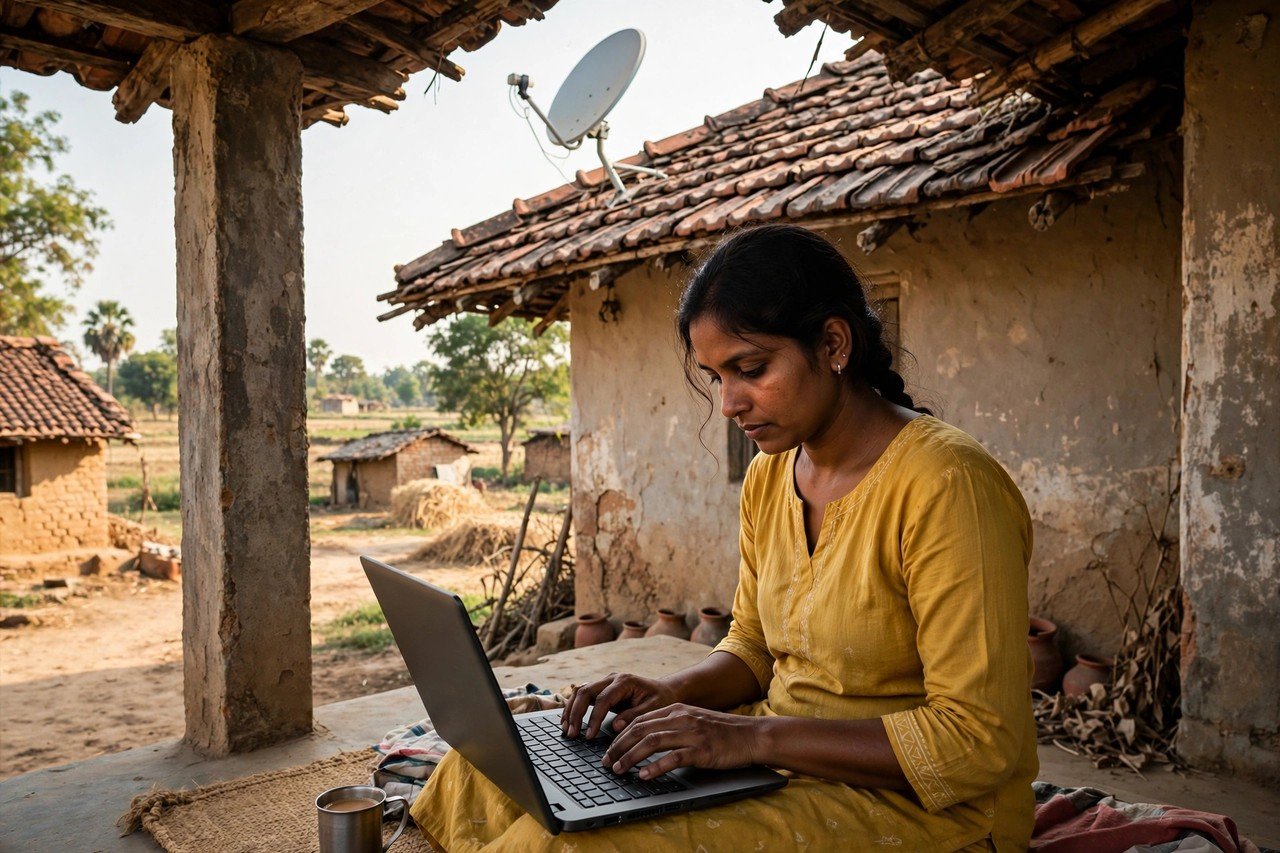
But “better” changes meaning where fibre doesn’t exist. In the Himalayas, in remote border villages, on ships, at mining and infrastructure sites, and in disaster zones — anywhere the nearest fibre line is a dream — Starlink’s satellite beam becomes the only high-speed option. That’s a niche, but for the people in it, it’s everything. And as connected devices multiply, remember that a smart home is only as good as its internet — which is exactly the problem Starlink solves for places fibre forgot. Once you’re connected, it pays to get more from that connection — like claiming ChatGPT Plus free in India while the offer lasts.
Who Should Actually Buy Starlink in India?
Let’s be blunt:
- Buy it if: you live or work somewhere fibre and reliable mobile data don’t reach — remote villages, hill regions, border areas, offshore work, or expedition teams. For you, Starlink is not competing with Jio; it is competing with nothing.
- Skip it if: you have fibre from Jio, Airtel, or BSNL available. Paying Rs 8,600 a month for 200 Mbps when Rs 399–899 gets you similar or better speeds makes no financial sense.
- Wait if: you are curious but price-sensitive. The placeholder tariff may drop — Musk himself said on X that if Starlink is too expensive, nobody will buy it and SpaceX will have to cut prices. The 2026–27 commercial launch could bring a very different number, closer to the Rs 3,000 figure floated in 2025.
The Verdict
Musk is right about one thing: competition genuinely benefits ordinary Indians. His October 10 outburst — and the needling of Ambani earlier in the week, including Saturday’s sharing of media-report screenshots alleging Reliance-linked political donations and social-media boosts (reported by dtnext on October 11) — makes for great drama. But drama doesn’t set tariffs.
The honest verdict on the Starlink India price: at Rs 8,600 a month plus a Rs 34,000 kit, Starlink is a specialist tool for the unreachable corners of India, not a Jio-killer. JM Financial’s read looks right — complementary, not competitive. For city dwellers with fibre at Rs 399, the math isn’t close. For a village with no signal at all, the math doesn’t matter. And for everyone in between, the smartest move is to wait for the real commercial tariff before deciding whether Musk’s satellites are worth your money.