
Astronomers have directly detected the first radio signal from an exoplanet ever recorded — a burst of radio waves streaming from a giant world 63 light-years away. The discovery, detailed in a new paper posted to the arXiv preprint server on September 15, marks the first time radio emission has been unambiguously traced to a specific planet outside our solar system.
Before the rumors start: no, this is not evidence of intelligent life. Scientists say the signal is produced by a colossal magnetic field driving planet-wide auroras — the same kind of natural light-and-radio show that powers Earth’s northern lights, scaled up to unimaginable proportions.
What Exactly Did Scientists Hear?
An international team led by Harvard and Smithsonian astrophysicist Kevin Ortiz Ceballos picked up repeating bursts of radio waves along with a steadier, persistent hum. The emission showed strong circular polarization — a telltale signature of auroral processes — at frequencies between 0.85 and 3.5 gigahertz. According to the researchers, the signal is consistent with electron cyclotron maser radiation, the same mechanism behind auroral radio bursts on planets inside our own solar system.
“I know radio signals are associated with searches for extraterrestrial intelligence,” said coauthor Edo Berger, a professor of astronomy at Harvard University, in comments reported by CNN. “But this is something very different.”
The bursts were traced to Beta Pictoris b, a gas giant roughly 12 times the mass of Jupiter, discovered in 2008. It is one of three known planets orbiting a young star about 1.75 times as massive as our sun. Because the radio waves traveled 63 years through space to reach us, what the telescopes captured is a snapshot of the planet as it was in the early 1960s.
A Magnetic Field Stronger Than Anything Ever Measured
The real headline may not be the signal itself but what it reveals. The recorded frequencies imply a magnetic field of at least 1.25 kilogauss in the planet’s emission region — making it the first direct measurement of an exoplanet’s magnetic field. For scale, that’s about 2,500 times stronger than Earth’s surface magnetic field and nearly 300 times stronger than Jupiter’s, the most intense planetary field previously known.
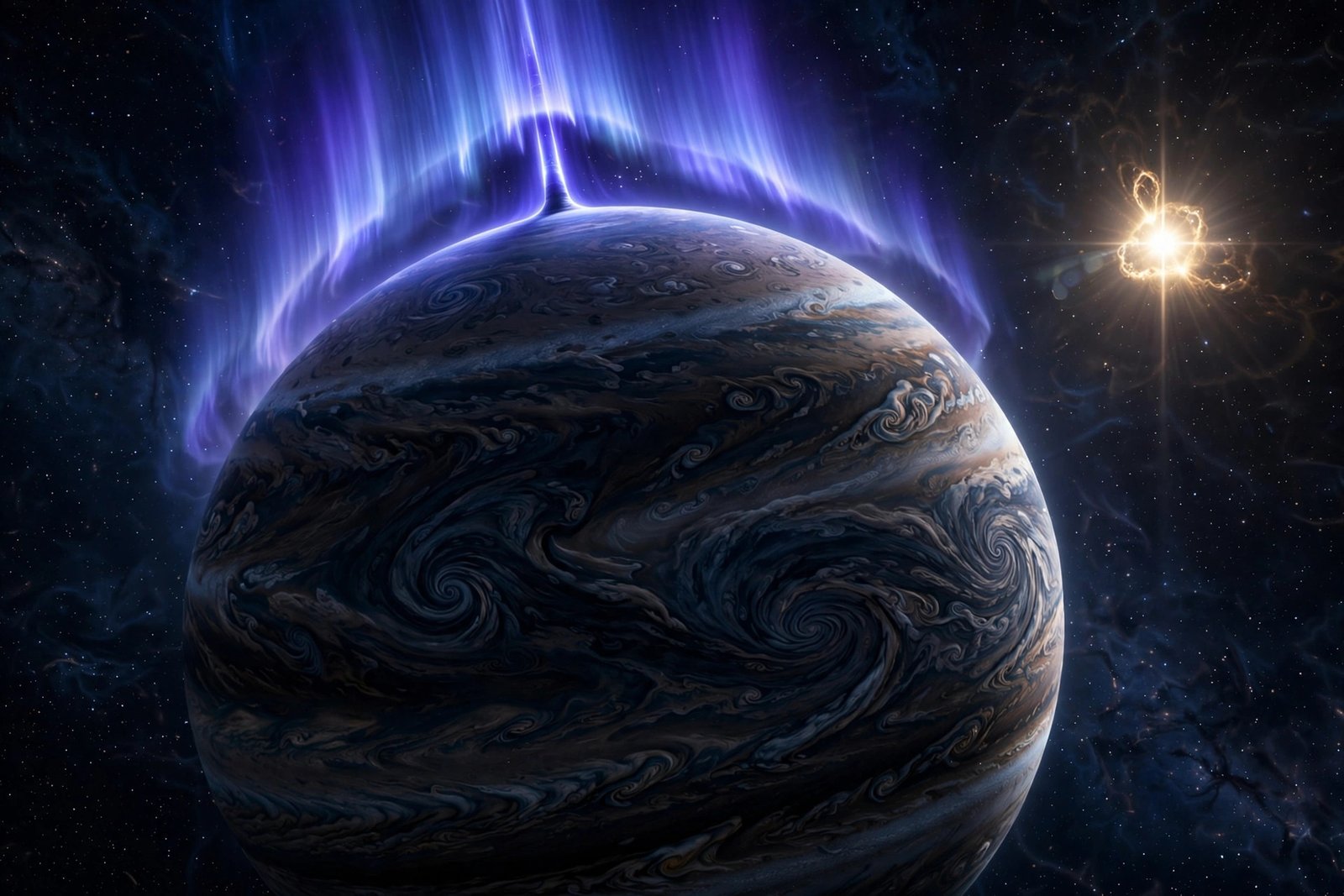
Magnetic fields matter enormously for habitability. They act as shields, deflecting the disruptive charged-particle winds that stars continuously blast outward. Earth’s own magnetic field protects our atmosphere from being stripped away by the solar wind — and until now, no one had ever measured the equivalent shield on a world beyond our sun.
How South Africa’s MeerKAT Caught It
The detection came from MeerKAT, a network of 64 linked radio telescopes spread across the Karoo semi-desert in South Africa. The team observed the Beta Pictoris system across four separate campaigns between February 2025 and May 2026, in the L (0.8–1.7 GHz) and S (1.7–3.5 GHz) radio bands.
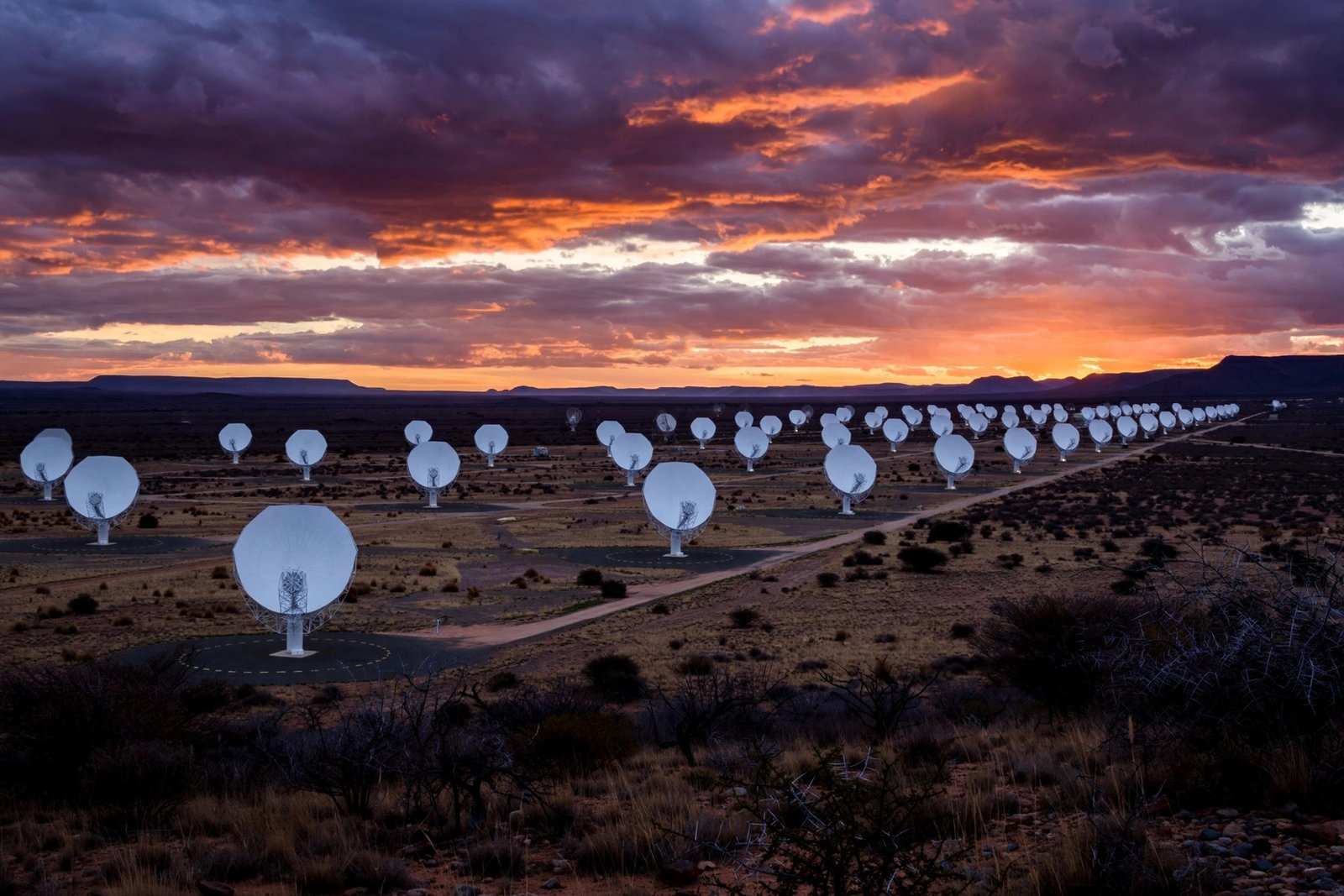
The trick was isolating the planet from its star. Because Beta Pictoris b sits extremely close to its parent star as seen from Earth, the researchers used distant quasars with precisely mapped positions as fixed calibration points to pin the emissions to the planet itself. They also got lucky: the host star is a hot A-type star with no strong magnetic activity of its own, meaning there was far less stellar magnetic “noise” drowning out the planetary signal.
Coauthor Yvette Cendes noted that the emission processes mirror ones seen on Earth and Jupiter — entirely natural, just on a far grander stage.
Why This Changes the Search for Habitable Worlds
Astronomers have catalogued more than 5,000 exoplanets, but almost everything known about them comes from light — starlight blocked during transits or the glow of their atmospheres. Magnetic fields were always the missing piece: they shape atmospheric escape and can determine whether a planet holds onto its air and water over billions of years.
This result proves that auroral radio emission can be used as a direct magnetic-field probe for exoplanets. The team now hopes to apply the same technique to other giant exoplanets — and eventually, to smaller rocky worlds where a measured magnetic shield could become a key clue in the search for habitable environments.
What Comes Next
The paper has not yet completed independent peer review, and the researchers caution that follow-up observations will be essential to confirm the auroral interpretation and refine the field-strength estimate. Astronomer Avi Loeb, writing about the preprint, called it a pioneering discovery and said it should motivate radio searches around more exoplanetary systems.
For now, the takeaway is poetic enough: from 63 light-years away, a young giant planet is crackling with radio auroras loud enough for our telescopes to hear — and that faint signal just gave us our first measurement of an alien world’s magnetic heart.
Based on reporting by CNN, the New York Post, Ubergizmo, and the research preprint posted to arXiv on September 15, 2026.